
Dr. Mario Anastasiadis (University of Bonn, Bonn-Rhein-Sieg University of Applied Sciences, C:POP), "Fake Pop as part of political disinformation and digital propaganda. A search for clues", impulse and talk


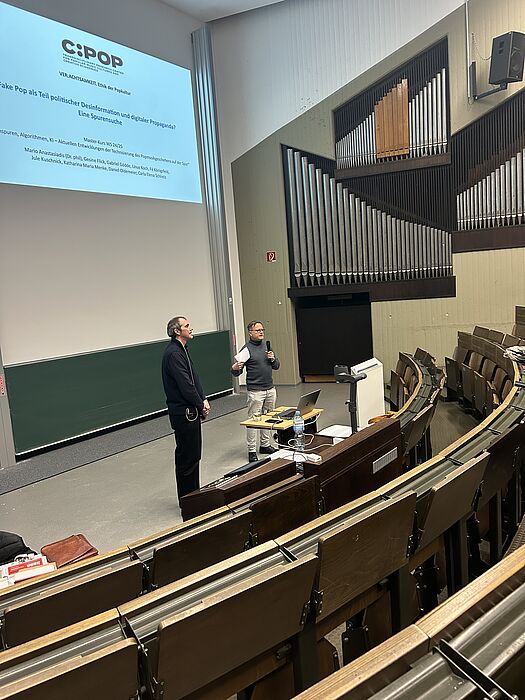
On Tuesday, 7 January 2020, the numerous visitors to the lecture series "Ver:Achtsamkeit: Ethik der Popkultur" had the opportunity to participate in the current Master's seminar "Datenspuren, Algorithmen, KI - Aktuellen Entwicklungen der Technisierung des Popmusikgeschehens auf der Spur" by Dr. Mario Anastasiadis. Dr Anastasiadis presented the content and results of this first, as yet unrepresentative search for traces in the seminar as a 'mandated' speaker.
A central aspect of the lecture was the examination of pop culture as a mirror of social realities and a means of exerting political influence. Using the illustrative example of Z-Pop, i.e. the propaganda symbol "Z" used in the war of aggression against Ukraine, it was explained how pop music was currently being used as part of Russian government propaganda and how nationalism, patriotism and the glorification of war are being propagated in this way in the context of the war in Ukraine. Star artists such as Shaman personify this cult, which uses pop as a tool for identity formation and ideological manipulation, sometimes subtly, sometimes explicitly, for example in music videos or song lyrics, at performances in war hospitals or at political events. These examples were used to illuminate "fake pop" - both pop generated by A.I. and as a medium of political disinformation. Pop moves between subversion, mass and power, questions norms and tests the boundaries of ethics and aesthetics, but is also deliberately instrumentalised itself (or allows itself to be instrumentalised, as in the examples mentioned). Dr Anastasiadis, who has been a lecturer at Paderborn University for years in the "Popular Music and Media" courses and a member of the organising "C:POP", concluded by stating that very important research here is still in its infancy and is challenging and that, surprisingly, generative A.I. obviously plays a subordinate role in the cases examined, while its progressive and regressive uses in pop music cultures, which are otherwise increasingly affected by it, should be examined more closely.
One student from the Masters seminar commented:
"Tracing Fake Pop and AI in Russia highlighted how music is used specifically to spread nationalist and ideological messages. In particular, the seminar focussed on how Z-pop artists spread Putin's messages with catchy melodies and patriotic lyrics. This search for clues has shown that this type of music can consciously steer the emotions of the population and support political agendas, which strongly influences the formation of opinion."
Text: Tina Götz