Prof. Dr Annegret Thiem (C:POP), "In the face of conflict: Mindfulness and the pleasure of seeing", impulse and performance and Prof. Dr Harald Schroeter-Wittke (C:POP), "Christmas as a pop cultural event", impulse and talk
On the past two Tuesdays, members of the C:POP Research Centre's Executive Board enriched the Ver:achtsamkeit round table event with exciting contributions:
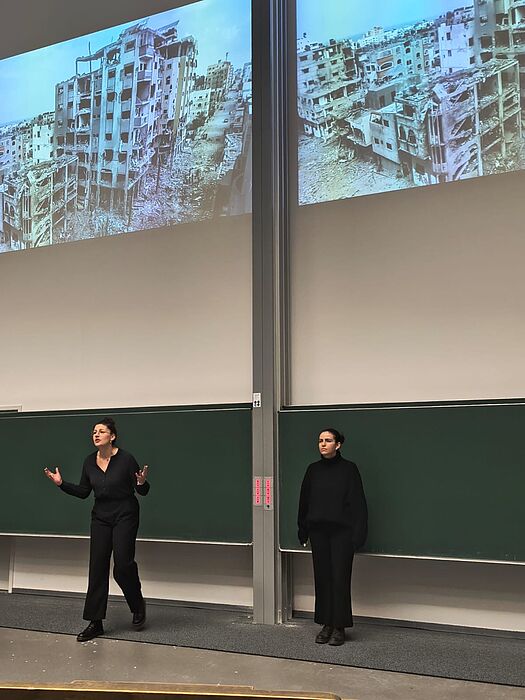
On 3 December 2024, Prof.in Dr. Annegret Thiem provided food for thought with her lecture "In the face of conflict: ver:achtsamkeit and the pleasure of seeing". She addressed the question of the extent to which photographers and the media should be granted the right to visualise and disseminate suffering in the form of images. Her impulse was accompanied by a performance by two students who represented the perspective of the victims and those photographed. Looking back, Prof.in Dr.in Thiem summarises her thoughts as follows:
"Ver:achtsamkeit links contempt and mindfulness. It is necessary to recognise the fine line between the two sides and to acquire a more conscious approach to ourselves and language. It would be good if we could also recognise our habits in everyday pop culture and learn to rethink them against the backdrop of ethical principles.
And, above all, to see through the so-called mainstream and not follow it unquestioningly." (Thiem)
On 10 December, Prof Dr Harald Schroeter-Wittke followed with a Christmas-themed lecture that examined the meaning of "Christmas as a pop cultural event" using video and song examples as well as theses he had developed himself. He scrutinised how Christmas is portrayed in pop culture and what social function it fulfils:
"Christmas and pop culture belong together. Since the 19th century, Christmas has been booming (as has pop culture) and has become the central civic celebration of Western modernity: the child, innocence (freedom from debt), the middle-class family, gift-giving, the festival of lights, coming home, the wish for peace and much more is celebrated there as a matter of course in society. Christmas no longer belongs to Christians, but is nevertheless Christian in nature. This multi-layered mix is also audible and visible in the pop music surrounding Christmas. Because Christmas occupies such a central position globally in terms of heortology (festival theory) and even in economic contexts, Christmas and its pop cultural artefacts are also a very good place to study mindfulness as the interplay of mindfulness and contempt. Christmas both reveres and despises." (Schroeter - Wittke)