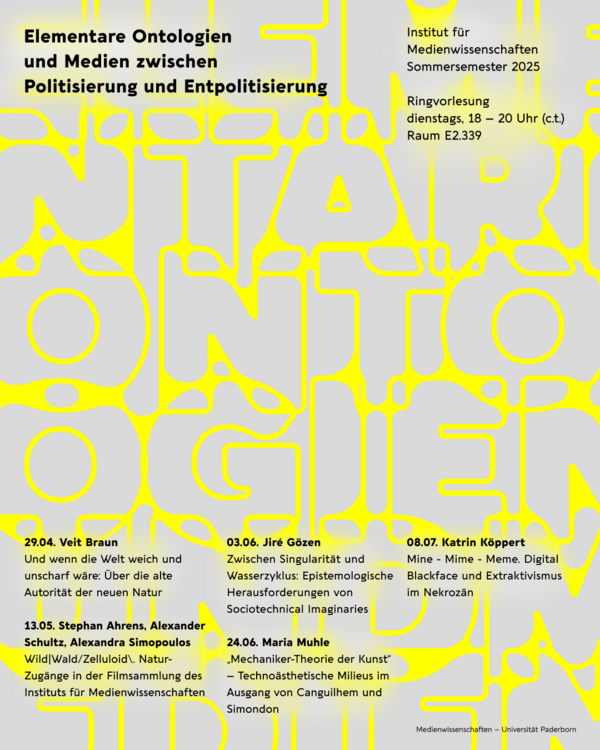
During this summer semester, our working group invited lectures and students to join discussions on elemental ontologies and media. A reading group provided the starting point for this series of lectures, focusing on questions of politicization and depoliticization through the natural, material, elementary and the non-human. Four lectures and an accompanying seminar dealt with criticism of prevailing knowledge systems, their potential alternatives and political thinking within relations, differences and the in-between.
Our guests looked at the new authority of the old nature, took a look at nature as an object in experimental films; questioned dominant epistemologies based on the embedding of people, technology, the environment, water and art; and examined the omnipresence of racialized formulas in Western technologies and cultures in regard to digital blackfacing.
These critical contributions have made us even more curious about alternative frameworks, political action frameworks and neglected ideas of being through fungi, bodies of water, forests, protozoa, memes and environments. We heartly thank our welcomed speakers Dr. Veit Braun, Prof. Dr. Jire Gözen and Dr. Katrin Köppert as well as our colleagues in the institute's film collection.
Further Reading:
Köppert, Katrin 2025: Meme(tische) Gespenster, in: TFMJ – Journal for Theater, Film and Media Studies, 68 (3-4), 2025.
Neimanis, Astrida. “Hydrofeminism: Or, On Becoming a Body of Water.” in Undutiful Daughters: Mobilizing Future Concepts, Bodies and Subjectivities in Feminist Thought and Practice, eds. Henriette Gunkel, Chrysanthi Nigianni and Fanny Söderbäck. New York: Palgrave Macmillan, 2012.
Schrader, A. (2010). Responding to Pfiesteria piscicida (the Fish Killer): Phantomatic Ontologies, Indeterminacy, and Responsibility in Toxic Microbiology. Social Studies of Science, 40(2), 275-306. doi.org/10.1177/0306312709344902 (Original work published 2010)