News from primary school education
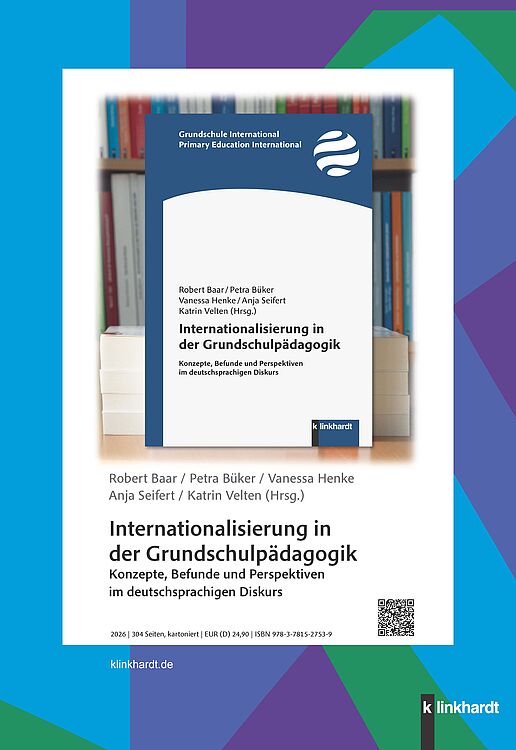
Internationalisierung in der Grundschulpädagogik. Konzepte, Befunde und Perspektiven im deutschsprachigen Diskurs.
Wie international ist die Grundschulpädagogik in Deutschland? Der Auftaktband der neuen Reihe ‚Grundschule international‘ beleuchtet erstmals systematisch den Stand der Internationalisierung von Grundschulpädagogik, Grundschulforschung und Lehrkräftebildung im deutschsprachigen Raum.
The transition from primary to secondary school from a child's perspective
How do children perceive the change from primary to secondary school? What challenges do they have to face and how do they deal with them? The author Jana Herding analyses these questions. In her dissertation, she analyses transition processes and coping strategies. The children's perspectives take centre stage: after all, it is a big step for the children that can play a decisive role in their educational biography, and it is important to provide them with the best possible support during this development process.
Children are experts in their own world - including at school. Based on their right to co-determination, as enshrined in the UN Convention on the Rights of the Child (Art. 12), they should be able to express their opinions, play an active role in shaping their lives and make a difference. In order to promote this potential, a cooperative project between Paderborn University and the Peter Gläsel Foundation Detmold has developed the research kit was developed. The scientifically sound and tried-and-tested material supports children in getting to the bottom of their questions and ideas as researchers, both on their own and together, and thus participating in changes to their school and non-school environment.
The Forscherkoffer is aimed at teachers and educational professionals who want to use the Forscherkoffer in practice, students who want to test and evaluate the Forscherkoffer in schools and scientists who want to investigate the concept and possible uses of the material.
Further information and insights can be found on our blog: https: //blogs.uni-paderborn.de/forscherkoffer/.
Several research kits are available to borrow from the Centre for Child Education Research (KiBi-Z) of the Primary School Pedagogy and Early Education working group.
A new project for the collaborative networking of teachers in innovative OER/OEP formats has been underway since May 2024: In PrimOER, the Paderborn University (Prof. Dr Petra Büker (project manager), Prof. Dr Gudrun Oevel) and Bielefeld (Prof. Dr Anna-Maria Kamin) are working together to expand the OER specialist community of "inclusive primary school pedagogy" established in NRW into a nationwide, interdisciplinary network. Here, opportunities for an interdisciplinary "culture of sharing" of expertise, knowledge, teaching concepts and teaching/learning materials are identified and used to achieve a professionalisation of the players and improved teaching quality in the area of dealing with heterogeneity and inclusion in the form of collaborative, open educational practices (OEP) by teachers from educational science and primary school-related subject didactics. The plan is for the participants to come together on various key topics such as diagnosis and support, media education, democracy education, shaping transitions, ESD, etc. and to develop and test a wide range of OEP concepts. An interdisciplinary evaluation takes place.
The Primary School Pedagogy and Early Education working group is known for its intensive cooperation with schools and daycare centres in the Paderborn education region. In view of the importance of application-oriented research and practice-orientated teaching, this network is now being expanded and enriched with a new format that brings students and teachers into an intensive exchange in the sense of a win-win situation: A new transfer office has been created, linked to the KiBi-Z (Centre for Child Education Research) university learning workshop established in the Department of Primary School Pedagogy and Early Education, which supports student teachers in the development of research skills and provides them with numerous services. Here, students and practitioners are brought together in a regular exchange in order to practise a so-called "culture of sharing".
In future, students, school administrators, teachers and educators will be able to network via a digital platform that is accessible to everyone. Student work (research findings from Bachelor's or Master's theses as well as teaching concepts developed in courses) will be made available here in a practical form. These can be used by practitioners and commented on in the form of feedback to students. A digital pinboard is integrated into the platform, which schools can use to post current questions and problems that can be dealt with as part of a final thesis. In addition to the digital platform, Paderborn University organises two round tables a year at which students and teachers can exchange views on current topics in primary school education and early education in a face-to-face format. In the interests of sustainability, corresponding cooperation agreements have already been concluded with 9 primary schools in the districts of Paderborn, Gütersloh and Soest.
In a founding meeting of the round table on 14 May, participants from 10 primary schools, the Centre for Practical School Teacher Training and the elementary sector developed a common understanding of cooperation and transfer in a participatory process and identified current topics for teaching, students' final theses and subsequent meetings. It became clear that transfer is not limited to the transfer of findings from science and research-related teaching into practice; rather, transfer is something multidirectional and requires the mutual opening of doors between university and practice.
Contact: katrin.glawe@uni-paderborn.de
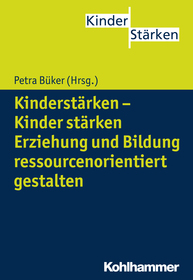
Children have enormous strengths for shaping their pluralistic, complex living environments, which need to be recognised and strengthened as competent co-actors by families, peers and educational subject areas and teachers. This basic idea is taken up in the new KinderStärken series of specialised books and examined in ten differentiated volumes along the life span from birth to the transition to secondary school. Further information can be found here.
Education is currently undergoing a profound process of change. In view of pluralisation, internationalisation, digitalisation and changing ideas of upbringing, learning and education, many new questions are arising for primary schools in particular. What does this mean for the work of primary school teachers?
- Petra Büker answers questions about the future posed by journalist Carolin Jenkner-Cruel in her podcast in the Peter Gläsel Foundation's "Future Talks" series. Have fun listening in!
- In her podcast for the Quality Agency for Schools (QuaLiS), Petra Büker presents important findings from research and design options for practice on the question of how to organise multi-professional teamwork in inclusive primary schools. Have a listen!