Arolsen Group - Volunteers in History and Memory
Welcome to the Arolsen Group! Below, you'll find information on our group's projects and what has happened so far. If you're interested, contact us to collaborate or participate.




Coming Up
Itinerary
The Milford / Mendel Jewish German family archives span nearly three centuries, nearly a dozen countries, and some 20,000 items: letters, photographs, diaries, documents, objects. During the spring of 2021 I planned with Gideon and Elias Mendel a series of Zoom seminars, which I organized, hosted, and convened, with family members, scholars, artists, writers, and museum curators to explore the Mendel archive. It was then that I learned of the Mühlfelder (later Milford) family archive, some 7,000 items that document the lives as well as the dislocation and murder of members of the Mühlfelder family, Jews from Thuringia (like their relatives, the Mendels) and Mannheim.
The Milford family archive came to Davidson in a dozen boxes in November 2021 with the support of grants from the German Embassy in the US and Davidson College, where, over the next semester, I worked with my students to teach them archival theory, ethics, and praxis so they could catalogue and digitize the artifacts in the archive. Guest scholars who visited that archive seminar were Dr. Teresa Walch, who studies Holocaust geographies and the ethics of photography, Dr. Sheer Ganor, who is a scholar of German-Jewish diaspora experiences, and Dr. Frank Mecklenburg, Senior Historian at the Leo Baeck Institute in New York (via Zoom).
My students produced a comprehensive finding aid with active links to images of the digitized artifacts. The matriarch and central figure of the archive, Toni Mühlfelder, who with her son Karl Hans, escaped Nazi Germany to the US, changed their names to Milford, kept and arranged the family’s records, including letters of her ex-husband Max who was deported from Mannheim to Gurs in October 1940, the first mass deportations of Jewish German citizens from Germany; Max was murdered in Auschwitz in August 1942. The letters of Max from Mannheim, then from Gurs, to his child Hans in New York from 1937 to 1942 trace the heartbreaking story of dislocation, internment, loss, until Toni and Hans (and we now as readers of this edited and translated correspondence) are met with the silence of Max’s death. My students traveled to Germany, Austria, and France during the summer of 2022, visiting the places in the archives and meeting with local archivists to seek further information about the Mendels, Mühlfelders, and other families. I arranged a symposium in Berlin in late July 2022 at which my students presented their findings; I co-curated an exhibition of artwork by Elias and Gideon Mendel based on their family archive at ARTCO Galerie Berlin; and produced a play “Humans in the Archive” by my former colleague Samer Al Saber (Stanford) about my students’ experiences as new archivists-in-training. The physical archive, catalogued by Davidson students, is now held at the Leo Baeck Institute in the Center for Jewish History in New York. Much of this story is documented on this site https://writingofmemory.scottdenham.net (no longer updated). Slides from my presentation to the Arolsen Group in June 2024 are here.
'Holocaust Literatures' - a third-year optional module at the University of Portsmouth
Holocaust Literatures is a module very close to my heart. I have been running it for the past ten years at the University of Portsmouth, usually attracting high student numbers mainly from the BA(hons) English Literature but also from the BA(hons) English Literature and Creative Writing or the BA(hons) Modern Languages. Increasingly over the past few years, the module is also attracting ever higher numbers of international exchange students whose contribution always add extra dimensions to the module. Holocaust education in the UK is very patchy - which is putting it mildly. Although the Holocaust is a named component on the National Curriculum and has been ever since the first National Curriculum in 1991, it is very much left up to teachers to decide in which subject they want to teach it (nominally of course in History but there are also options to include it in English Literature, in Religious Education, in Sociology...), how they are approaching the topic and how long they are spending on it. The result is that some pupils have detailed Holocaust education spanning subjects and weeks while others spend, maybe, one History lesson on it or others again are given The Boy in the Striped Pyjamas as a set text at Key Stage 3 without being given historical context or, importantly, historical facts to support their reading of this very problematic text. For this reason, my module spends the first two weeks on providing as much historical context as possible, starting with Nazi ideology, covering anti-Jewish legislation, persecution and moving on to the directed extermination of European Jewry in Nazi-occupied Europe. We also spend a lot of time discussing modes of commemoration, covering literature, film, museums and memorials before moving on to a study of five primary texts covering survivor accounts (Elie Wiesel's Night), moving to second-generation narratives (Art Spiegelman's Maus), Holocaust fiction and perpetrator accounts (Bernhard Schlink's The Reader and Rachel Seiffert's The Dark Room) before concluding with Patrick Modiano's The Search Warrant and questions of 'how to write' history. In addition, students work in small groups of 3 to 4 in order to present on an additional text. This presentation needs to cover some author background (was the author a survivor? a child of survivors? an author without personal connections) and assess whether or not students feel that the text might be a suitable addition to Holocaust education. Students then submit this presentation as part of a 'creative portfolio' where they produce some 'art work' inspired by the text they have been reading. This can be a poster, an illustrated timeline, a box containing their presentation etc. In the past, students have created some wonderful art work that I have then exhibited publicly at Portsmouth's annual Holocaust Memorial Day. Displaying their work to members of the public has helped the students feel part of a wider community of Holocaust 'educators' and the majority of them have really excelled in this module and taken its learning forward into their chosen careers.
Dr. Gerhard Dirks' story consists of resilience and innovation. While escaping Nazi and Soviet forces during the final year of WWII and the few years thereafter, Dr. Dirks laid the groundwork for modern computing. His inventions, including magnetic data storage and rotating memories, were crucial in the development of early computers. His work and his collaboration with inventors such as Konrad Zuse would lead him to California in 1960 to work for IBM. Despite many setbacks, such as the failure to launch his personal computer prototype, Dirks' contributions have had a lasting impact on the digital world. His story highlights the intersection of war, technology, and the relentless pursuit of innovation.
On Monday, the first of December, Rosanne Mosely-Gore presented her memoir "Songs from the Suitcase: Inhabiting an Inheritance" to the Arolsen Group. The book retells her family's life-stories and heritage such as her German Jewish father's escape from Nazi Berlin on a Kindertransport, and the heritage of her Russian mother and grandmother as well as the family's life in London. Moseley-Gore discussed the genesis of this memoir and the family archive of letters and photographs that shaped it.
Stefan Daubrawa is a journalist with the Austrian broadcasting corporation (ORF). For the past couple of years he has been committed to preserving the unique artwork of his grandmother, Recha Kohn, and to making it accessible to a wider audience by digitising her massive oeuvre. Born in 1920 in Frankfurt am Main, the daughter of Polish-Jewish immigrants, Kohn‘s pictures are haunted by her experiences of persecution and displacement. (www.recha-kohn.com)
Clint Smith is an American writer, poet and scholar. His article “Monuments to the unthinkable” evaluates how America still can’t figure out how to memorialize the sins of it’s history and asks whether they can learn from Germany. In this meeting, we looked at the plans for the “With These Hands” memorial at Davidson. Clint Smith will present a new poem written for the commemoration of the memorial sculpture next year.
In this discussion we focused our attention on some issues particularly relevant to the current state of Germany’s Erinnerungskultur (culture of memory). As a start, the German students gave a brief presentation on recent opinion polls in Germany concerning Holocaust commemoration. Prof. Ehland also introduced a recent article by Israeli philosopher Omri Boehm, published in the Süddeutsche Zeitung, in which he reflects on the role and relevance of cultures of memory today. Additionally, the the text of Richard von Weizsäcker’s historic speech from May 8, 1985 was discussed in this context.
Yale Strom (violin) is one of the world's leading ethnographer-artists of klezmer and Romani music and history. With his master’s in Yiddish studies Strom decided to do extensive ethnographic research in Eastern Europe to research klezmer music and culture among the remnant Jewish and Romani communities. Since his first trip to the former East Bloc in 1981 Strom will speak about his field research and how conducting it during the East Bloc era was different from the post-Berlin Wall collapsing era. Strom's research formed the core repertoire of his klezmer/Romani band Hot Pstromi, as well as became material for his books, documentary films and photo exhibition.
Shonaleigh Cumbers is a storyteller—not just any storyteller. She is a Drut'syla, a keeper of a living storytelling tradition you may never have encountered. This tradition once flourished in Jewish families but was almost entirely lost during the Holocaust. Almost—because, as far as we know, Shonaleigh is the last surviving Drut'syla. She learned her craft from her bubbe, her grandmother, Edith Marks.
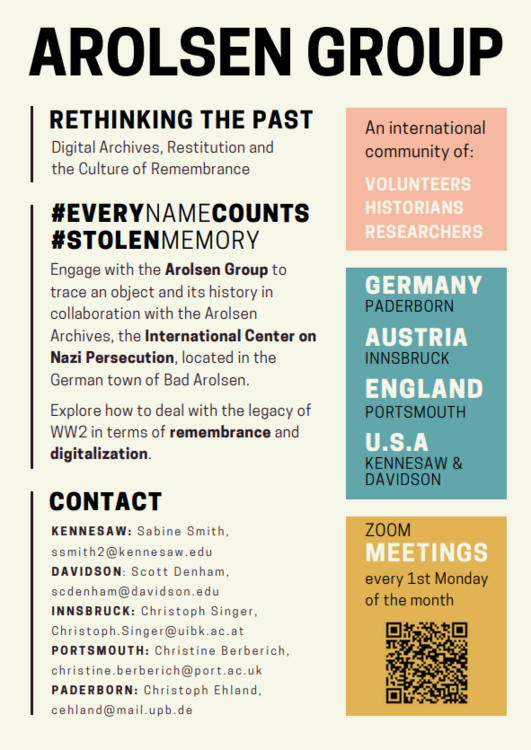
Reconnecting the Arolsen Group with its origins, Ulrich Rittmann from the Arolsen Archives presented the institution’s current projects as well as its history. Through #EveryNameCounts, the archive actively engages participants in memory work. The project and travelling exhibition #StolenMemory traces personal objects and searches for their rightful owners. Finally, Ulrich Rittmann also introduced the learning module “Suspicious” from the Arolsen Archives’ educational platform.
Dominik Markl is Professor of Theology at the University of Innsbruck. He is one of the initiators of the “Justman Project”, which engages with the life story of Leokadia Justman, a Jewish woman from Poland who fled to Tyrol. She was imprisoned by the Gestapo but managed to escape. After the war, she published her memoir, which was later rediscovered and republished to great public interest. Dominik Markl will speak with us about the project and about the psychological challenges involved in this kind of memory work.
The family memoirist, the archivist, the historian, and certain other archetypes of the writer-of-the-past are often oppressed by history. That is, the objects that they consult are preceded by the history those objects are said to represent. How can one look, for example, at an old image of a soldier without first thinking about the war in which he was to fight?
In his memoir, The Third Solitude: A Memoir Against History, Ben Libman attempts to bracket the histories that attend the family objects, documents, and photographs that were passed down to him, in order to see them "as they are.” Is this way of seeing even possible? And if it is, is it somehow better — or truer?
How do we keep the memory of the Holocaust alive when the last survivors are no longer with us? Many descendants of Nazi persecution victims grapple with this question in very personal ways. Some travel to the countries their ancestors came from, search through archives, visit graves, or meet with fellow descendants at commemorative gatherings. Many of these take the form of so-called roots journeys: explorative journeys into the past, across countries and generations.
What makes roots journeys particularly fascinating is that they rarely stay focused on facts alone. Although they often begin with the goal of retrieving lost family information, the most significant moments tend to be emotional and personal rather than documentary. And they take a striking variety of forms. Some become memoirs - such as Edmund de Waal's The Hare with Amber Eyes or Meriel Schindler's The Lost Cafe Schindler, in which a British lawyer returns to her family's Austrian-Jewish past in Tyrol. Others become novels, graphic novels, or films - from Jonathan Safran Foer's Everything Is Illuminated to Jesse Eisenberg's recent film A Real Pain. Still others take the form of physical pilgrimages: visits to memorial sites, or participation in organisations such as the Kindertransport Association, where descendants gather to share and preserve their families' stories. Notably, roots journeys have also emerged from the perspective of descendants of perpetrators, adding another layer of complexity to how this memory work unfolds.
This research project examines several of these works and memory practices. It asks in particular what they reveal about the ways in which memory is passed down across generations and across borders, languages, and cultures. The project focuses on children and grandchildren of Holocaust survivors - the second and third generations - from English-speaking countries as well as from Austria and Germany. Their perspective on history is quite unique: they are close enough to the past to feel its weight, yet distant enough to ask questions that survivors themselves may never have been able to voice. These questions are further complicated and enriched by a transcultural outlook - by the experience of looking at one culture's history through the eyes of another.
Lisa Castello shares her data from site visits and staff interviews at two regional Holocaust museums in the US (in 2015 and again in 2026) to explore how museum spaces perform memory through revision. Her initial research questions are: How have these museum spaces become more or less performative in their reframing and how do they seek greater engagement with younger, more intergenerational audiences?
Felix Behler presents his article: “Where Do We Come From”: Holocaust Memory and the Ethics of Analogy in Michael Rosen’s On the Move (2020)
Abstract: This article examines the representation of Holocaust memory in Michael Rosen’s poetry collection On the Move: Poems About Migration (2020). Situating the collection within current debates about the shifting contours and changing cultural function of Holocaust remembrance, the article argues that Rosen mobilises his personal Holocaust “postmemory” (Hirsch 2003, 415) primarily as an analogical framework through which contemporary experiences of migration and displacement are read and interpreted, connecting, as he does, the persecution of European Jews during the Second World War, more specifically, with the effects of the global refugee crisis since 2015. Drawing on close readings of the collection, the article focuses on three interrelated dimensions of Rosen’s poetics: (1) the construction of a form of mediated witness in which personal memory, ancestral trauma, and contemporary concerns consistently converge and overlap; (2) the collection’s use of what I call “cross-temporal intra-textual resonances” to establish connections between narratives of violence across different historical contexts; and (3) the creation of a poetic voice of authority grounded both in the valorisation of Rosen’s personal (post)memory and – more problematically – in the poet’s ostensibly superior moral sensitivity. While On the Move seeks, often quite explicitly, to establish an imaginative connection between the Holocaust and more contemporary experiences of violence and displacement, the article argues that Rosen’s approach is marked by a series of profound tensions, arising principally from the overt didacticism and moral urgency of his poetic voice. By using the Holocaust as an ethical and didactic framework for understanding and evaluating processes of migration and displacement across history, the collection continually risks flattening historically specific forms of violence into a generalised humanitarian lesson.
Projects/Trips
Digitising the Bowl
For this project, the Paderborn group is focusing on this seemingly mundane object of a soup bowl. We're trying to find out more about its history in connection to the pogroms that disenfranchised Jewish people.
A couple of things we - assume - to know so far: The bowl was stolen from a Jewish family in Bremen, presumably by neighbors, after the Jewish family fled/was removed from their home. We've contacted experts in porcellain that think the bowl was made by the company "Hutschenreuther" and dated between 1934/1935. Due to the rococo style of the bowl, we believe it was owned by a family that was financially at least a member of the middle class.
In this step, we worked with our university's 3D-Lab, that helped us to digitize the form of the bowl. Our intention was to see what technology offers for these processes of restitution. Can we, maybe, make this bowl accessible to people around the world without physically needing to ship it? What are the advantages over pictures, if any?
We also learned that this process remains complicated unless you have the money/resources to fully reconstruct an object in a digital manner. We could get as far as capturing the shape rather easily, but the near perfect representation of the physical bowl in a digital format including its surface would take a tremendous effort. We're still working on possible avenues to continue this effort.


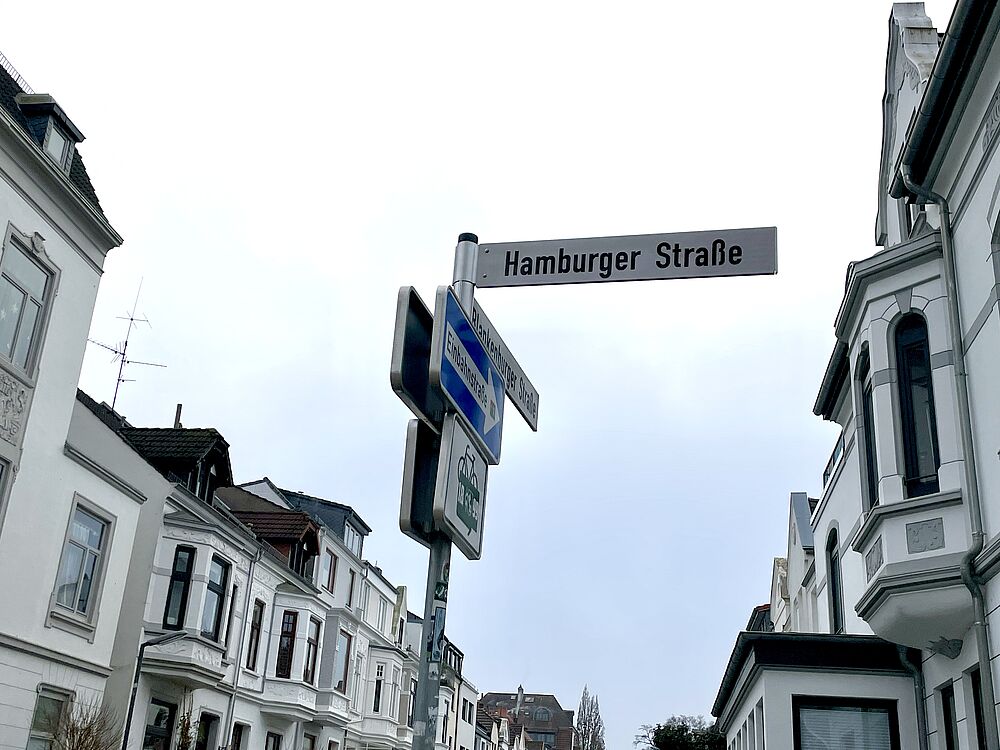
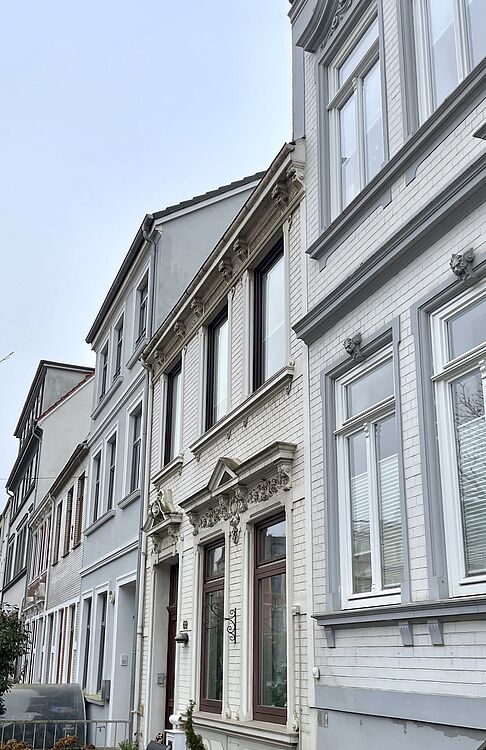
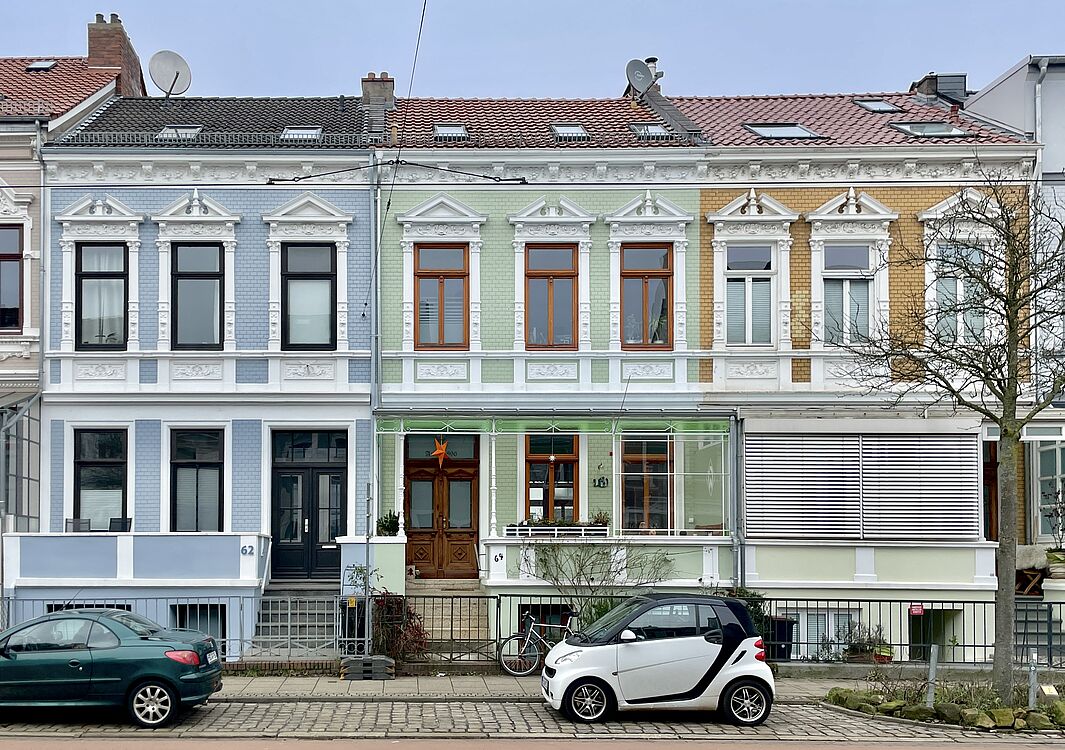
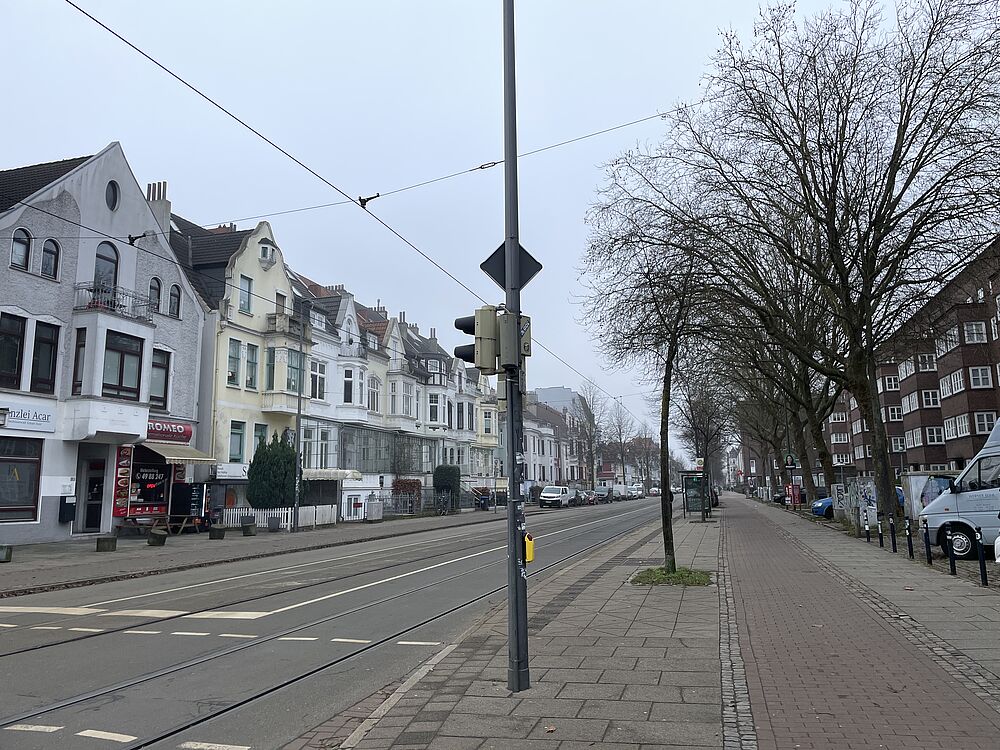
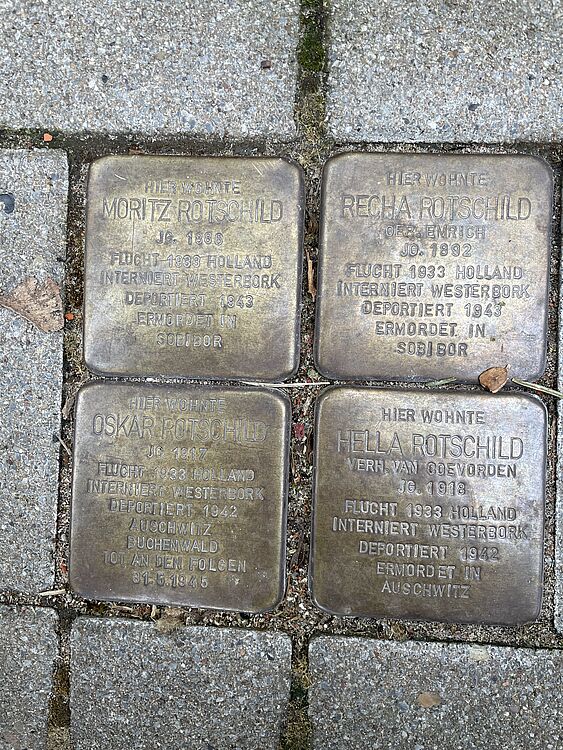
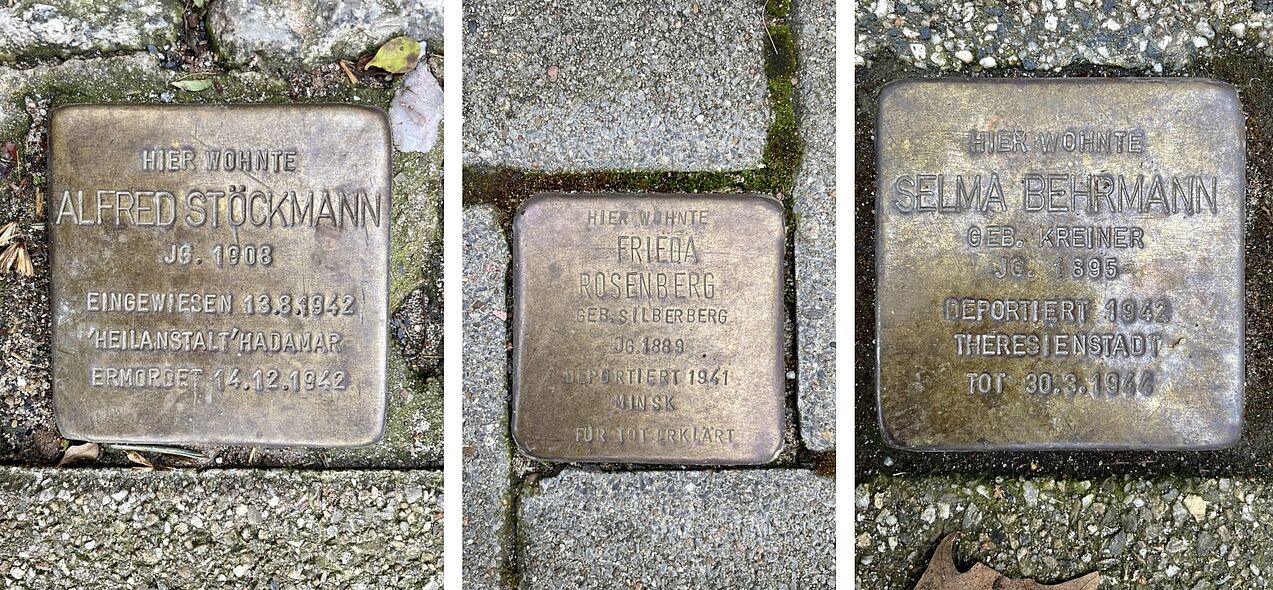
When we took the student trip to Bremen, we took the chance to go to the Hamburger Straße, attempting to trace the soup bowl to its suspected origins. Although we don't know for sure if the bowl originated from one of these households, the street took on a "memorial" quality to us, as we traced the stumbling stones on the main and side streets. Each of the houses marked by these stones could be the origin of our bowl, each of the names, of the varied histories of deportation and flight could be a record of where the bowl's complicated history began. We tried contacting somebody who researched and wrote a brief biography on one of the victims, because she lives on the Hamburger Straße but, sadly, she wasn't home and we couldn't talk to her. More on this in the February meeting, for now, some impressions of this experience: