
Interdisciplinary Studies of the Paderborn Graduate Centre for Cultural Studies
Editors: Sabiene Autsch, Andrea Becher and Volker Peckhaus
The new series "Interdisciplinary Studies of the Paderborn Graduate Centre for Cultural Studies" takes into account research work that has emerged in the context of the Graduate Centre of the Faculty of Cultural Studies at Paderborn University (GKW). The volumes consistently specify the epistemic potential of interdisciplinary work derived from the research findings. Interdisciplinarity is not merely understood as the compilation of research findings from different disciplinary perspectives. Rather, it relates these perspectives and thus broadens horizons. The series claims to stand at the intersection of academic research and reflection on one's own academic practice by focusing on the particularities of one's own disciplinary perspective and knowledge culture. The aim of the series is to provide a thematically open platform for different approaches within interdisciplinary cultural studies.
Requests for publication should be addressed to the editors.

Volume 1: Knowledge transfer. The task, challenge and opportunity of cultural studies research
Editors: Anda-Lisa Harmening, Stefanie Leinfellner, Rebecca Meier
The term knowledge transfer has become increasingly important in recent years. It refers to the circulation of knowledge between systems, organisations or parties, for example between universities and society. This does not 'only' mean the transfer of scientific knowledge into social contexts, but rather - beyond the acquisition and transfer of knowledge - the dialogue and discourse formation between science and society. This volume focuses on the emerging tasks, challenges and opportunities of cultural studies research. Contrary to the assumption that projects from the field of cultural studies would remain in the field of the abstract, it presents examples of cultural studies research that take theory and practice into account and illustrate the interlocking of theoretical findings and their involvement in social discourses.
Available (German only) as:
Volume 2: Data - Culture - Society. Cultural studies perspectives on data society as a social transformation
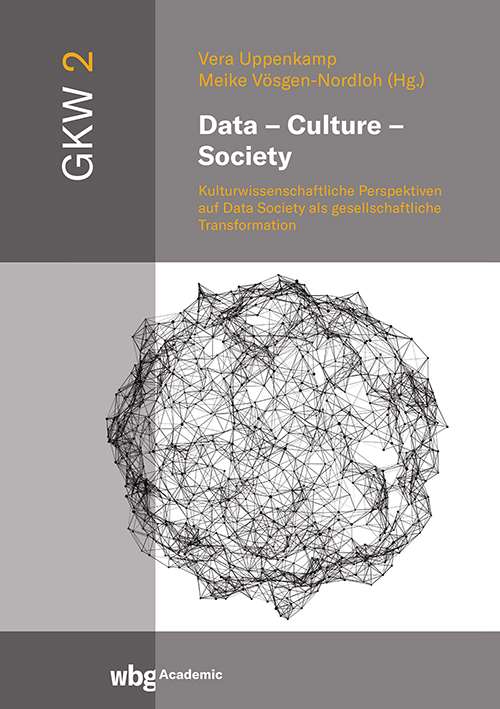
Editors: Vera Uppenkamp, Meike Vösgen-Nordloh
Today's (social) life is increasingly permeated by digital and digitalised data. Cultural studies is less interested in technical processes than in the significance of digital transformation for society, culture and people. The anthology explores this significance by understanding various disciplines of cultural studies as a connecting element between data and society.
In this framework, the introductory words of the volume first summarise the digitised society - the data society - as an object of cultural studies research and discuss associated questions about the change in social order patterns as well as the changes in knowledge and the role of people. The other contributions explore these questions in greater depth using different disciplinary and methodological approaches: The first two contributions shed light on the relationship between humans and the digital, focusing on the (social) interaction between people and robots and between data and subjects respectively. Three further texts discuss the use and design of digital transformation processes - such as content on social media - for the educational context or science communication. The volume concludes with two contributions on digital spaces and their impact on people, with a particular focus on virtual reality and video games.
The anthology invites readers to make the complexity of social transformations towards a data society tangible by drawing on anthropological, social theory and media studies perspectives. It opens up opportunities for interdisciplinary reflection on the transformative power of digitalisation and provides impetus for further research.
Available as:
Volume 1: Knowledge transfer. The task, challenge and opportunity of cultural studies research
Editors: Anda-Lisa Harmening, Stefanie Leinfellner, Rebecca Meier
The term knowledge transfer has become increasingly important in recent years. It refers to the circulation of knowledge between systems, organisations or parties, for example between universities and society. This does not 'only' mean the transfer of scientific knowledge into social contexts, but rather - beyond the acquisition and transfer of knowledge - the dialogue and discourse formation between science and society. This volume focuses on the emerging tasks, challenges and opportunities of cultural studies research. Contrary to the assumption that projects from the field of cultural studies would remain in the field of the abstract, it presents examples of cultural studies research that take theory and practice into account and illustrate the interlocking of theoretical findings and their involvement in social discourses.
Available (German only) as: