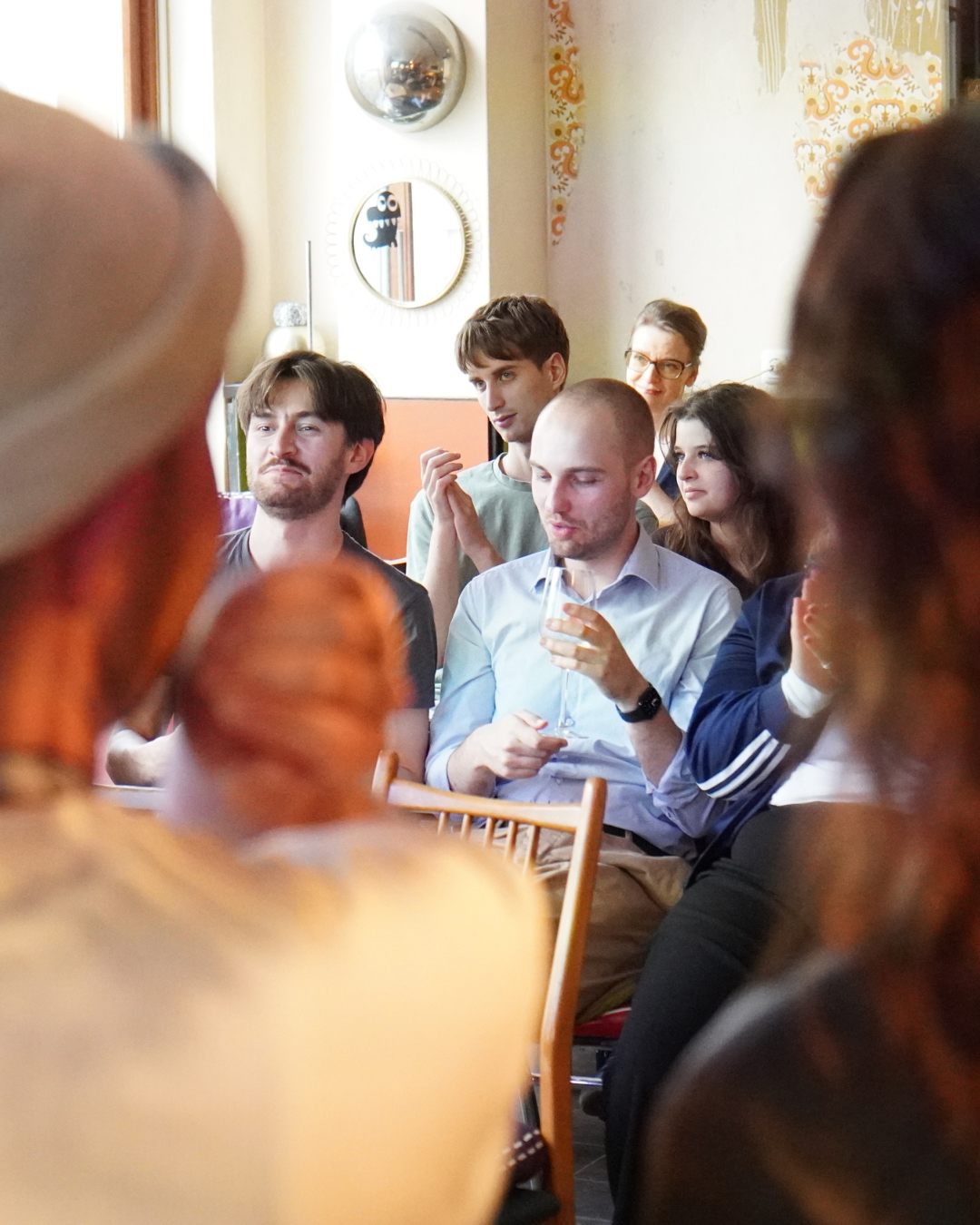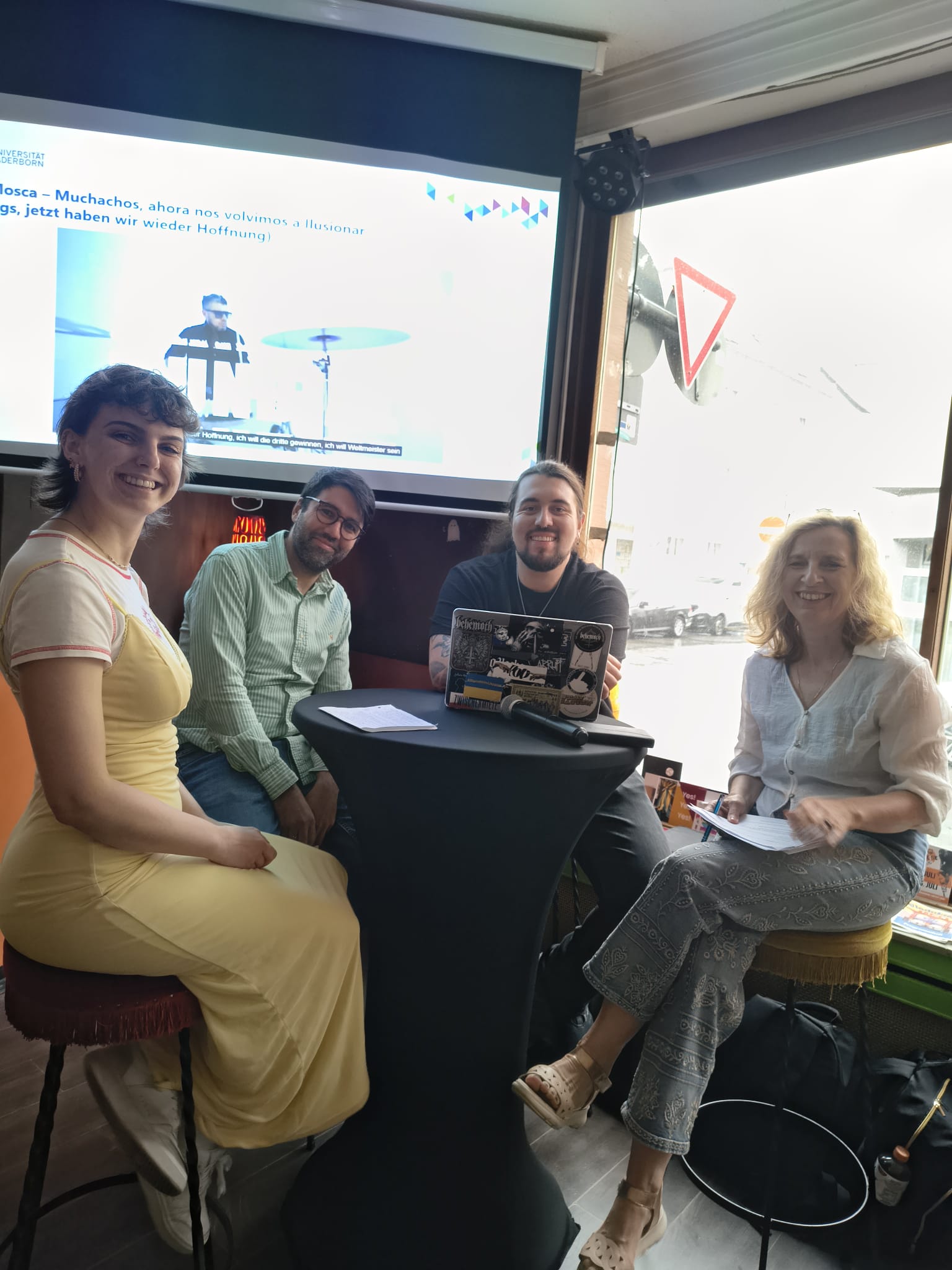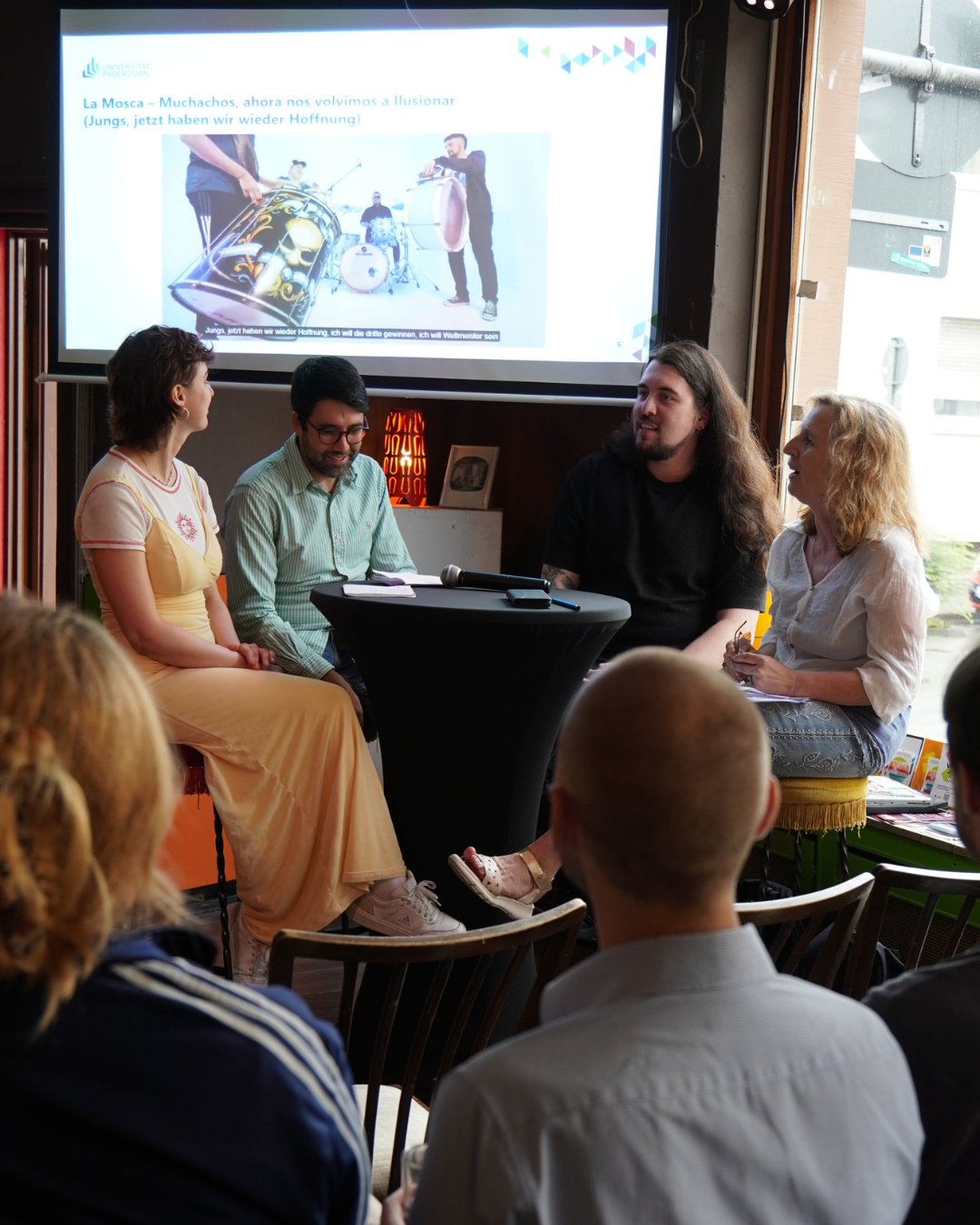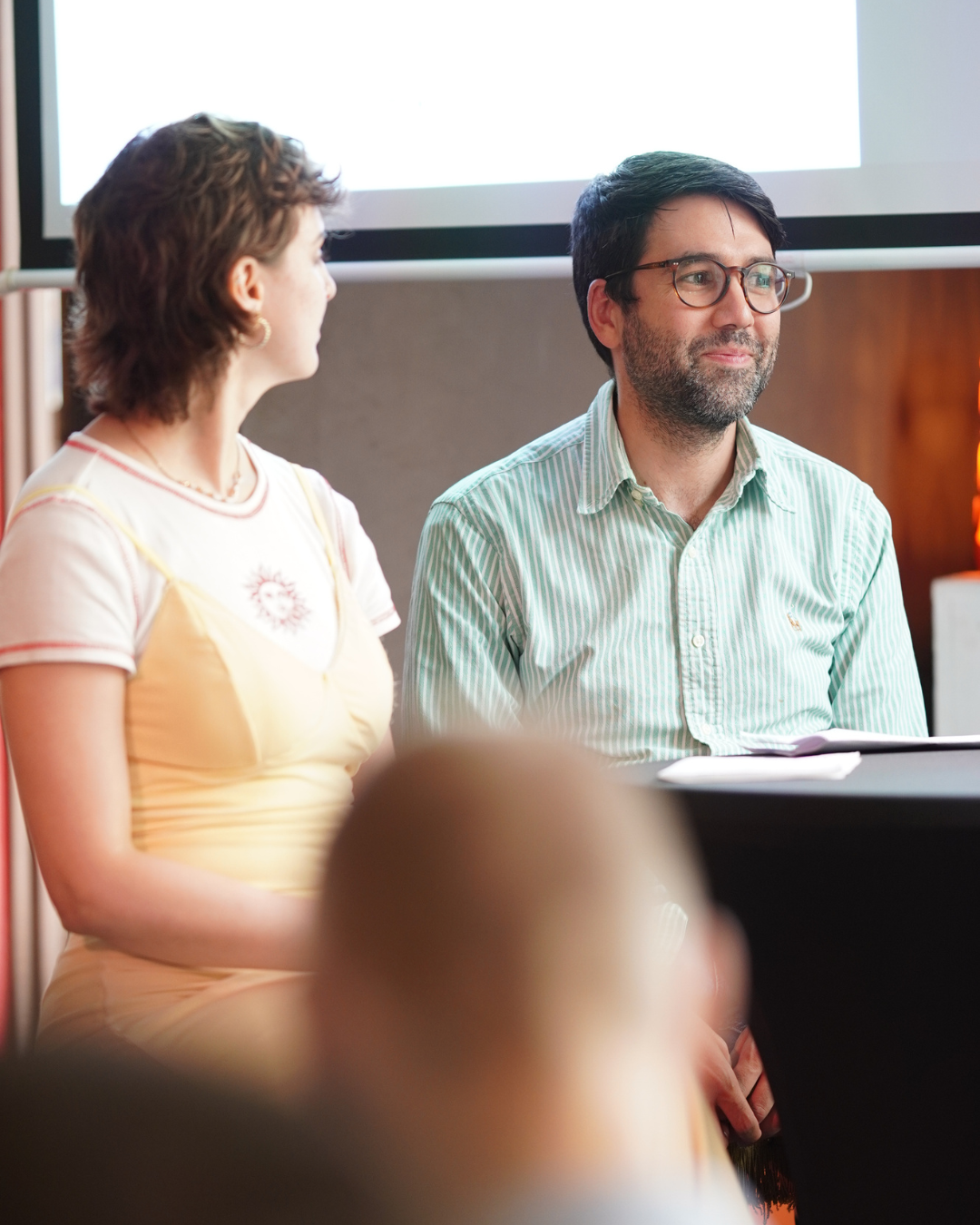
Under the theme “¿11 Amigos? Football & Pop Culture”, the 23rd edition of Popkritik took place on 2 July at Sputnik in Paderborn. The event was organised by the “Popular Music and Media” and “PopMediaCulture” study programmes at Paderborn University. Together with the audience, Dr. Resul Karaca from the Institute of Romance Studies, Dorothee Stehle, a student on the “PopMediaCulture” Master’s study programme, and David Corrales, a research assistant on the “Popular Music and Media” study programme, discussed fan chants, national identities, AI-generated football music and the increasing commercialisation of the FIFA World Cup. The event was moderated by Prof. Dr Annegret Thiem and David Corrales.
Dr Resul Karaca opened the event with an Argentine fan chant that originated as early as 2021 and became particularly well-known during the World Cup in Qatar. The song links Lionel Messi and Diego Maradona with the history of Argentina, the longing for the World Cup title and historical events such as the Falklands War. The verses have been rewritten time and again and adapted to new successes. Later, the original band re-recorded the song themselves, turning it into a sort of unofficial anthem of Argentine football.
The ensuing discussion focused primarily on how closely football in Argentina is linked to national pride, history and religion. For example, there is a church named after Maradona with its own calendar and its own commandments. This quickly raised the question: is football perhaps a kind of religion in itself? It fosters a sense of community and belonging, but at the same time can also distract from social problems.
David Corrales then turned his attention to AI-generated fan songs and current trends on social media. Using various examples, he demonstrated how quickly new football songs can be produced and disseminated using AI tools. Many of these songs, however, sounded very similar: loud, rhythmic, short and structured according to the same pattern.
A discussion therefore took place with the audience as to whether the true spirit of a football song is lost in the process. Often, a catchy rhythm, a clear melody or effective call-and-response structures were missing. This sometimes gave the impression of ‘music by algorithms for algorithms’. At the same time, the question arose as to who actually produces such songs, with what intention and for which audience.
Dorothee Stehle then offered a Colombian perspective. The song presented was commissioned by the national team and combines different rhythms, regions and slang from across Colombia. The focus is above all on the shared sense of ‘we’: it is not setting oneself apart from the opposition, but rather community, passion and Colombian identity that characterise the song. This was followed by a discussion on authenticity. Do fan chants have to originate directly from fan culture to foster a sense of community? Or can professionally produced songs fulfil this function too? The Colombian example showed that even an officially commissioned song can foster a sense of identification if different groups can relate to it.
Of course, Shakira could not be left out. Her close connection to past FIFA World Cups, her dance challenges on TikTok and Instagram, and her appearance as part of the new half-time show highlighted just how closely football, pop music and global marketing are intertwined. A fitting comparison was made: Shakira is now almost as much a part of the World Cup as Mariah Carey is of Christmas.
Many thanks to everyone involved and to the audience for the fascinating contributions and the lively discussion.