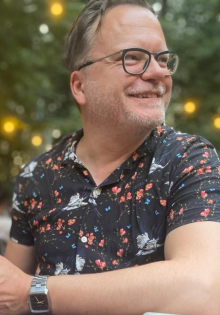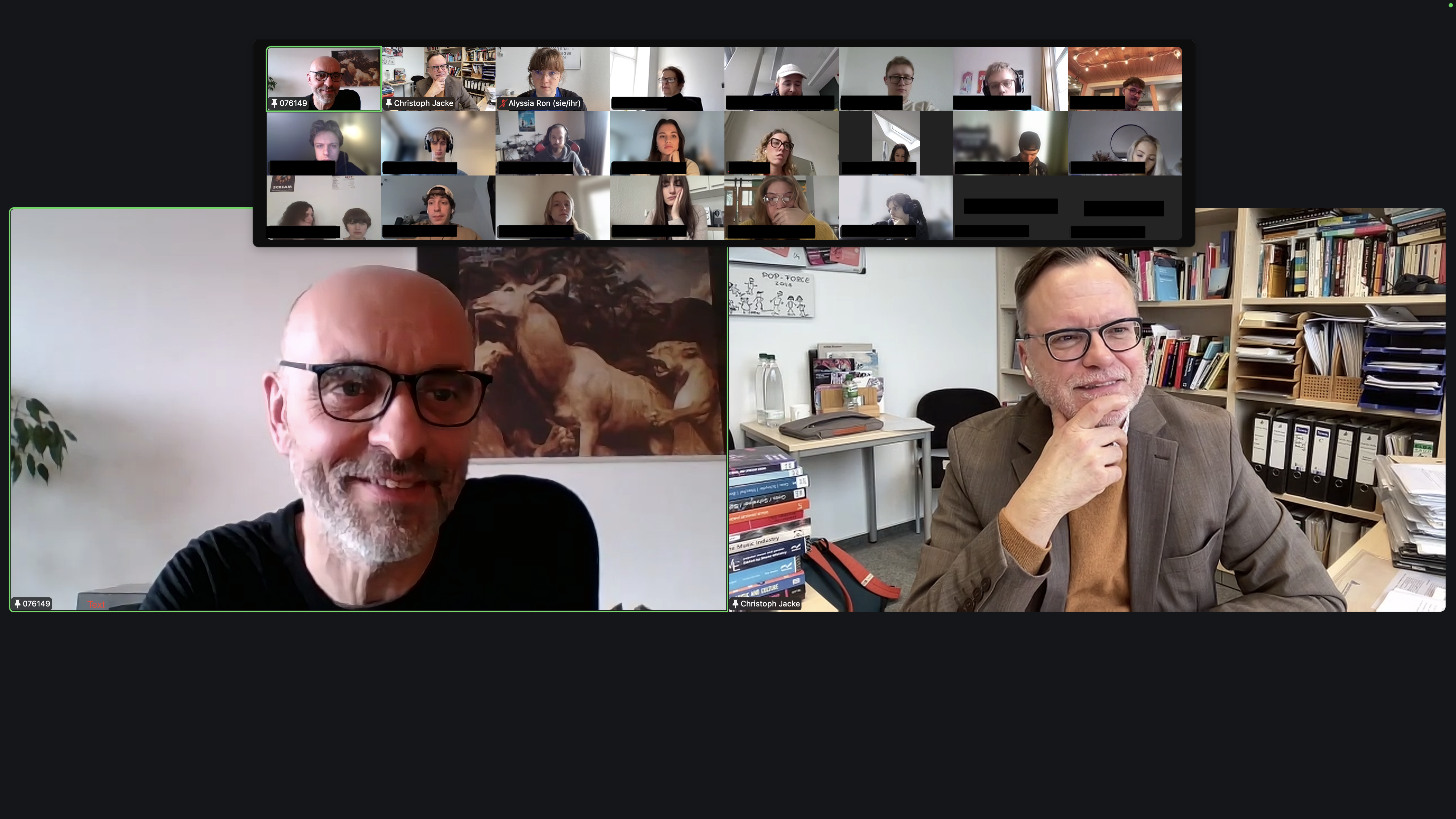
Jan Frohne (musician with Düsenjäger and Schnelles Geld, employee of Green Hell Records) tells the students about his stage experiences, songwriting processes, influences and the New Year's Eve at the turn of the millennium when the band Düsenjäger was founded:
"We weren't up for all this New Year's Eve hustle and bustle. Why don't you all do what you want, we'll do our own thing and hole up in the rehearsal room with the four of us."
The departure from the mainstream reflected in Düsenjäger's genesis is also evident in the band's music. Inspired by post-punk bands such as Joy Division, EA 80 and The Cure, the artists' songs deal with the crises that affected society then and now. The fears of the future that were already known in the 1980s, triggered by the nuclear threat and environmental destruction, among other things, are all too present for the younger generations today: climate change, the international shift to the right and wars are also putting society and individuals of the 2020s under pressure and can be recognised in artistic adaptations.
Frohne: "In the 1980s it was said: Oh God, the world will end in five years. And something similar is hanging in the air now. It's also noticeable in creative processes, where it falls on fertile ground."
The students were particularly interested in how Frohne incorporates political messages into his texts: "I found his view of writing texts very exciting, as political themes have always been part of his work and often appear subliminally rather than directly named. Surprisingly, this approach has hardly changed for him over the years. Songs like 'Herbstmanöver' in particular clearly show how timeless and changeable political messages in music can be." (Ronja Fischer, student of pop music and media)
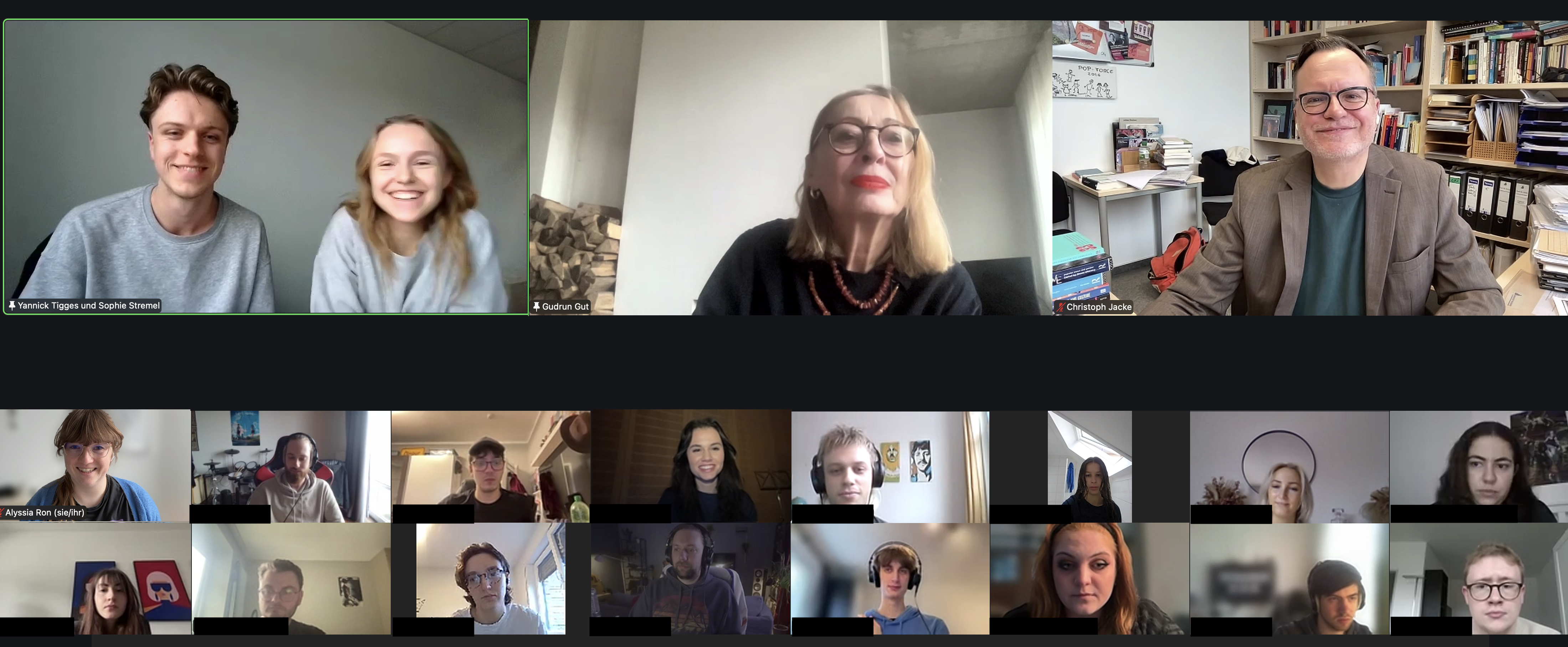
A week later, Gudrun Gut (author, artist, label maker and music producer) visits the seminar and answers the students' questions. After living in Berlin for a long time, Gut recently moved to more rural areas in the Uckermark. The musician (including Malaria!, Mania D., Einstürzende Neubauten and Ocean Club) and DJ is currently writing a book about her self-founded label "Monika Enterprise", which has been committed to the dissemination of female music, especially in the indie and electronic fields (e.g. Masha Qrella, Barbara Morgenstern, Lucrecia Dalt), since it was founded. Even though Gut still has a flat in Berlin, she lives in the Uckermark - to vote against the AfD, as she says.
Between the lines of the lively conversation, it becomes clear that political, feminist commitment has always been part of Gut's work. Yannick Tigges and Sophie Stremel, two students from the seminar, have studied Gut's work and life in detail in advance, provided literature and media tips and moderated the session. From Gut's former university life in West Berlin to gender roles in the music industry, as in punk, to Gut's fandom for Lana Del Rey: the students had many questions for Gudrun Gut, who answered them in a detailed and entertaining way.
Gut's art was not only inspired by the time, but also in many ways by the respective location: West Berlin as an island city was "totally neglected", the artist reports. Did she and her friends want to reappropriate the bleak city with cheerful music? "Cheerful? It wasn't there at all. It was just grey, grey, grey." He continues: "Berlin was a field for experimentation. We entertained ourselves, because there was nothing going on, we organised our own concerts. Then we realised that others felt the same way as we did."
Music was simply made - in pubs or cafés, backyards or basements.
Gut: "The music on the radio or the music that was going on around us had nothing to do with reality back then in West Berlin. That's another reason why I wanted to make music myself."
It wasn't just about the sound or the genre. The voice of the woman, literally and metaphorically, was missing. There were too few female bands. The music industry was (and still is, as Gut emphasises) male-dominated, and so women never had a confidence bonus, but always had to deliver twice. This is exactly where she came in with her label "Monika Enterprise". Gut remembers that she was often asked why she only worked with female artists:
"Which wasn't true at all - but was anyone else asked why her label only released male bands? No. So I said that I choose according to my personal taste."
Student Ronja Fischer says of Gudrun Gut's visit: "She left a strong impression with her versatility and clear attitude. Her view of the music industry and everything surrounding it from a female perspective was particularly impressive: the openness about the obstacles that have been placed in her way as a woman, but without ultimately letting them stop her."
Other students are also enthusiastic about the seminar visitors. Yannick Tigges reports how he also learnt something for future interviews: "I found it exciting to see how quickly both artists thawed out - which I think was because the format had a relaxed atmosphere. It wasn't too dry, there were lots of lively and creative questions. In both cases, the phenomenon occurred that the artists let even more details, background information and further thoughts off the leash if you gave them some time after their statements and didn't rush straight in with the next question. Time went by far too quickly in both sessions!"
Both Jan Frohne and Gudrun gut agree that not everything would be the same if they could repeat the 1980s. But they wouldn't let go of the music. The students were fascinated by the short journey through time to the eighties and back.
Author's note: The quote in the title comes from Ronja Fischer.
Text and pictures: Alyssia Ron