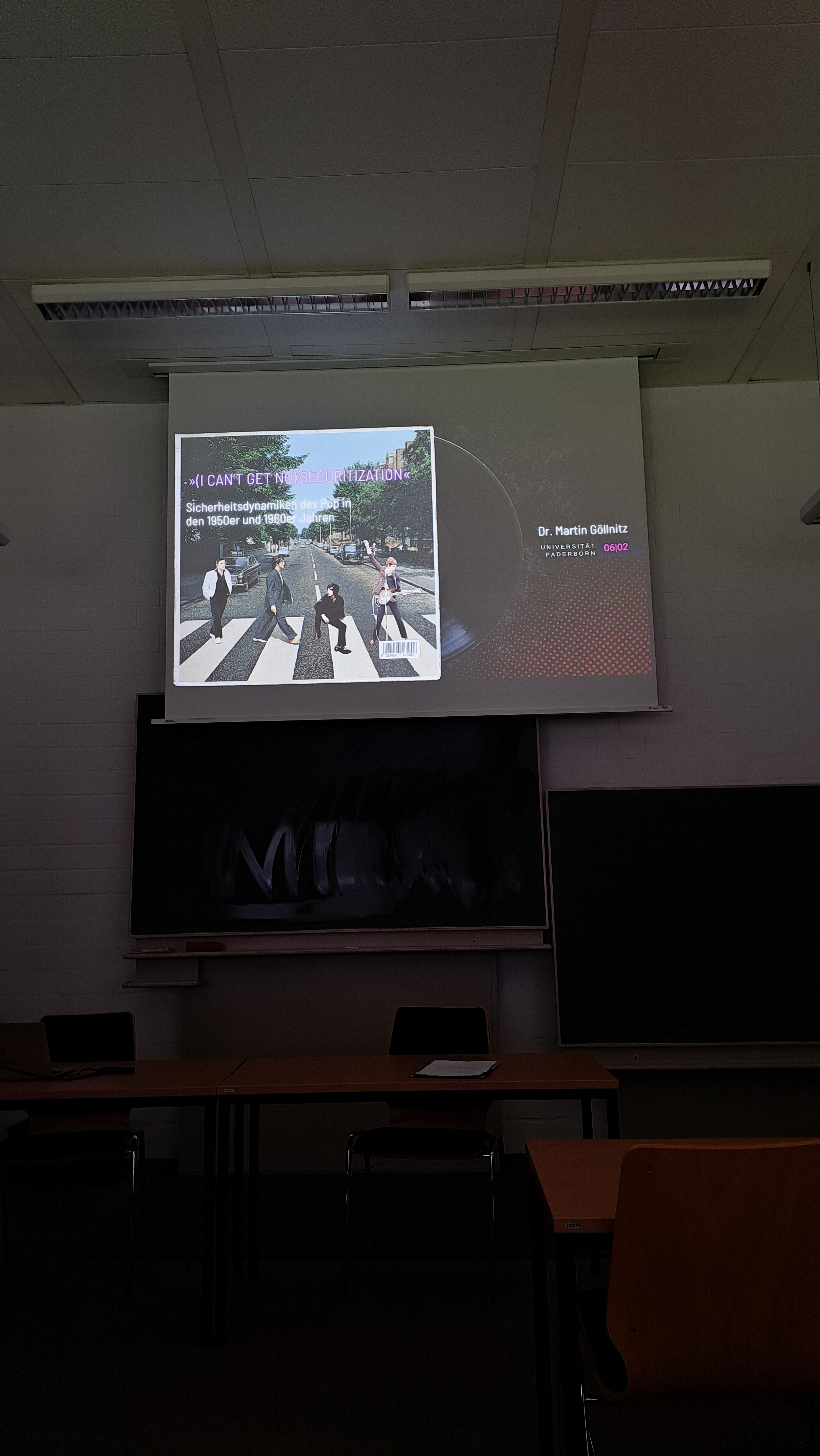
On 2 June 2026, the Contemporary History Research Unit and the C:POP Research Centre hosted a lecture by Dr Martin Göllnitz entitled ‘(I can’t get no) securization’. Security dynamics of pop in the 1950s and 1960s. The focus was on the question of how pop music in the old Federal Republic was perceived not only as entertainment, pleasure or youth culture, but also as a potential threat to notions of social order.
Dr Göllnitz demonstrated that rock ’n’ roll, beat and pop were repeatedly associated with insecurity in post-war West German society. This was not just about music in the narrower sense, but also about the body, clothing, hairstyles, dance moves, gender roles, volume and emotions. Pop thus became a cultural phenomenon around which social questions of norms, values, order and security coalesced.
Taking pop as a cultural practice as its starting point, the lecture made it clear that pop music must always be considered in the context of social spaces, media developments, and forms of production, distribution and reception. Pop therefore arises not only in the song itself, but also in the practices, interpretations and negotiations that accompany it.
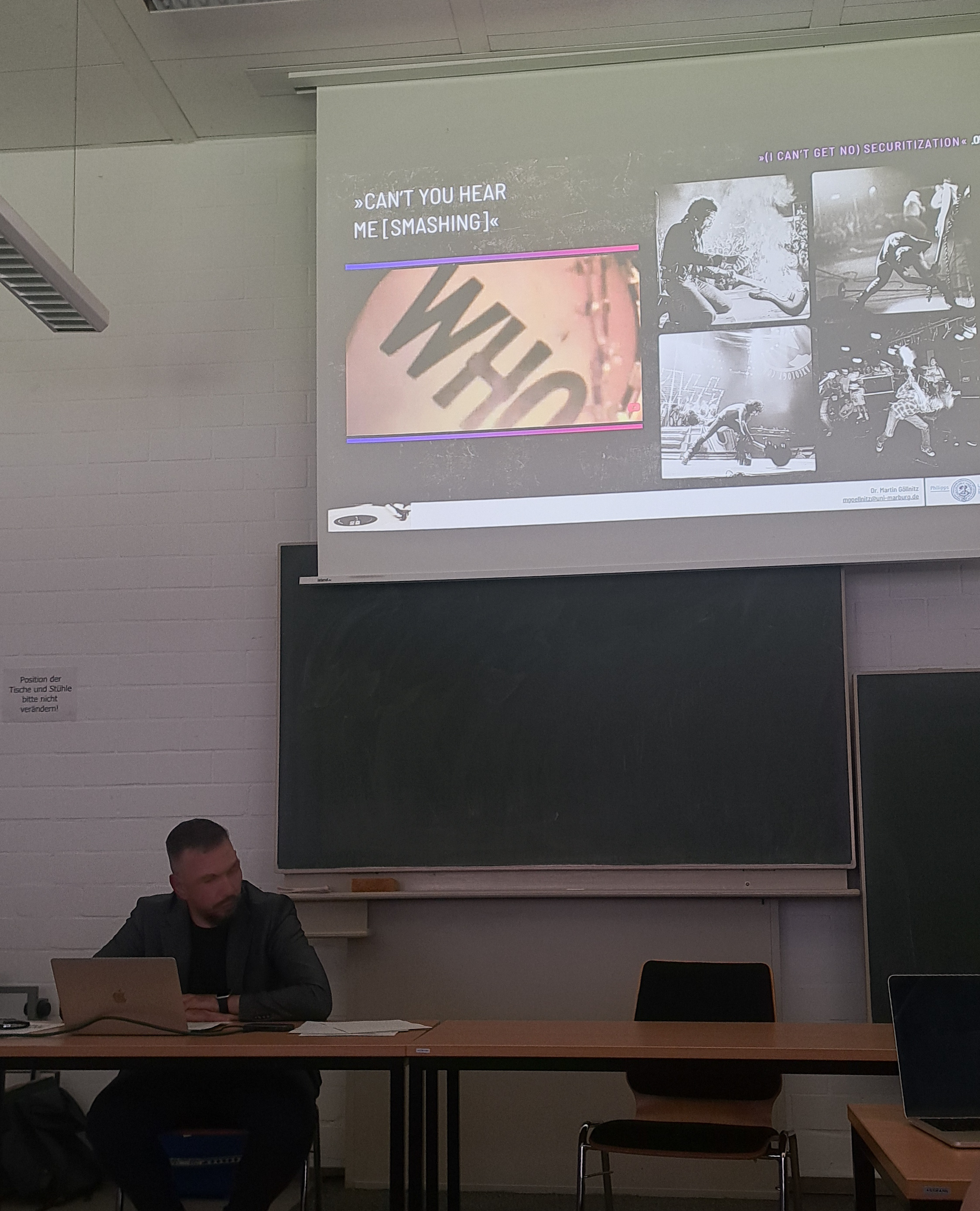
This was illustrated particularly vividly by the example of The Who. Distorted guitars, feedback, excessive drumming and the smashing of instruments were described in the lecture as pop-cultural practices that unsettled, provoked and were quickly associated in the public perception with noise, loss of control and ‘acoustic violence’. The destruction of guitars was thus interpreted not merely as a stage gesture, but as part of a specific pop aesthetic that elicited social reactions.
At the same time, Dr Göllnitz made it clear that pop history should not be told solely as a succession of scandals or as a simple generational conflict. Pop consumption was not only rebellion, but also pleasure, a sense of belonging to a group and a social practice. It was precisely this simultaneity of fascination and perceived threat that made pop a space for social negotiation.
Using the concept of ‘securitisation’, the lecture finally turned its attention to how pop came to be made into a security issue in the first place. It was not pop music per se that was automatically dangerous, but rather certain sounds, body images, performances and behaviours that were socially marked as unsafe and interpreted accordingly.
With the subsequent discussion on the coexistence of pleasure and insecurity or chaos, his methodological approach and a more nuanced “concept of media”, Dr. Martin Göllnitz’s visit can be described as a success. We look forward to his next visit and thank the organisers.