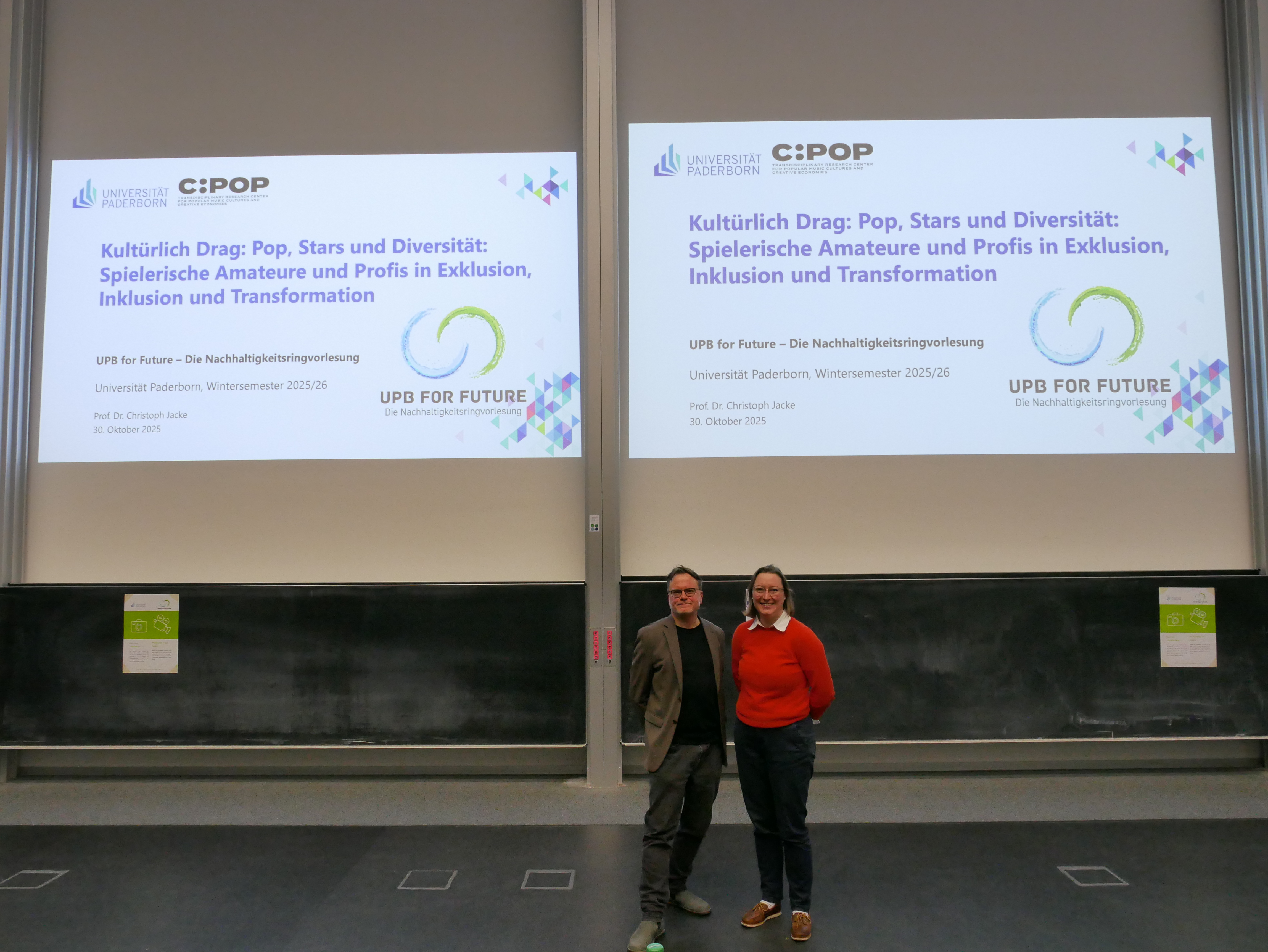
Prof. Dr. Christoph Jacke, Deputy Managing Director of C:POP, Transdisciplinary Research Centre for Popular Music Cultures and Creative Economies gave an insight into popular music studies as part of the public lecture series for sustainability "UPB for Future" on 30 October 2025.
The lecture, which was organised for the fifth time at Paderborn University in collaboration with the department of Prof. Dr René Fahr, head of the Behavioural Economic Engineering and Responsible Management, focusses on the ecological, social and economic dimensions of sustainability.
With this in mind, Prof Dr Jacke presented pop (music) cultures as seismographs of society: What do we learn about social contexts such as sustainability in a cultural sense when we look at pop (music) cultural phenomena?
In particular, this lecture entitled "Cultural Drag: Pop, Stars and Diversity: Playful Amateurs and Professionals in Exclusion, Inclusion and Transformation" focussed on stars and productions with regard to sustainable development and gender, based on the goals of the United Nations: reducing inequality, utilising opportunities and strengthening representation.
Using various examples, Prof. Dr. Jacke illustrated how these goals are important in the context of popular culture. With the song "You are my sister" by former Anthony and now Anohni and the Johnsons (here featuring the queer 1980s superstar Boy George), Prof. Dr. Jacke brings one of many examples of gender diversity and transitions in pop, and using a picture of Nick Cave in the film "This Much I Know To Be True", the negotiation with and of the role of the male (rock) star is illustrated by the star himself. In doing so, Prof Dr Jacke repeatedly provides an insight into the theories, methods and research questions of Popular Music Studies.
At the same time, the co-director of the successful Paderborn "Popular Music and Media BA/MA" programme also pointed out that pop itself is not always sustainable or progressive, but sometimes even regressive or destructive, but in any case sometimes works in a playful, sometimes exclusionary way. "With the right subgenre, you can still really annoy your parents, contrary to popular opinion," he says, referring to regressive opposition, for example, to fan cultures in right-wing rock. The negative consequences of pop (music) cultures for the environment cannot be dismissed either: one example of this is the considerable energy consumption of streaming platforms, as Jacke emphasised with reference to his own conference and publication.
Another example cited by Prof Dr Jacke was Taylor Swift, who can hardly go unmentioned in a current lecture on pop (music) cultures. He referred to the Swiftie fan cultures of the billionaire superstar, which can be very exclusive even in a generally open-minded atmosphere, develop their own codes ("Easter eggs") and thus often evoke communalising forces at the same time.
The following conclusion by Prof Dr Jacke will be remembered at the end of the lecture:
"Pop music CULTURES are just as (...) exclusive, inclusive and transformative as other cultures as interpretive foils of models of reality and overall social seismographs - they just have historically more socially legitimised playful freedoms in culturally homeopathic doses."
Text and photo: Alyssia Ron
Contact:Prof. Dr Christoph Jacke